

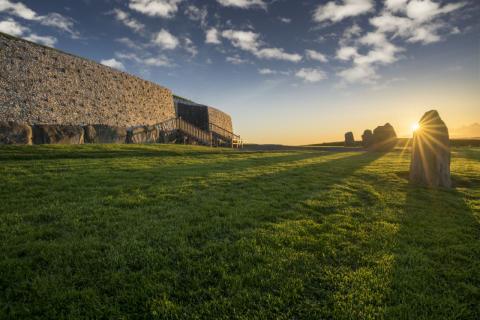
Welcome to the Boyne Valley Heritage FAQ page. Here, we’ve gathered answers to some of the most frequently asked questions about the rich history, ancient traditions, and remarkable landmarks that make the Boyne Valley so unique. From prehistoric sites to vibrant cultural heritage, this guide is designed to help you better understand and explore one of Ireland’s most storied landscapes. If you don't find the answer to your question below, please feel free to email us on info@discoverboynevalley.ie and we can help you further.
Where is the Boyne Valley?
The Boyne Valley is located in the east of Ireland, primarily spanning across County Meath and parts of County Louth. It follows the course of the River Boyne from its source to the Irish Sea, covering a landscape rich in history, heritage, and scenic countryside.
The region is just north of Dublin, making it easily accessible—typically less than an hour’s drive from the capital and Dublin Airport. Known as the heart of Ireland’s Ancient East, the Boyne Valley is famous for its concentration of prehistoric sites, medieval towns, and cultural landmarks.
What are the must-visit heritage sites in the Boyne Valley?
The Boyne Valley is home to some of Ireland’s most iconic sites, including Newgrange, Knowth, and Dowth (part of the Brú na Bóinne UNESCO World Heritage Site), the Hill of Tara, Trim Castle, and Monasterboice. Each offers a unique insight into Ireland’s ancient past. You can find a full list of heritage sites here.
Do I need to book tickets in advance?
Yes, it is highly recommended to book in advance, especially for popular sites like Newgrange and Knowth, as access is limited and demand is high—particularly during peak seasons and major events.
Are guided tours available?
Most major heritage sites offer guided tours, which are highly recommended as they provide deeper insight into the history, archaeology, and mythology of the region.
How much time should I allow to visit the main sites?
Visitors should allow at least half a day to explore Brú na Bóinne, while other sites like Trim Castle or the Hill of Tara can typically be visited in 1–2 hours each.
Are the sites suitable for children and families?
Yes, many heritage sites are family-friendly, with visitor centres, interactive exhibits, and open spaces for children to explore.
Are the heritage sites accessible?
Accessibility varies by site. Visitor centres are generally accessible, but some ancient monuments may have uneven terrain. It’s best to check individual site details in advance.
What is the best time of year to visit?
The Boyne Valley can be enjoyed year-round, but spring and summer offer longer daylight hours and better weather. Autumn is also a beautiful and quieter time to visit.
Can I visit multiple sites in one day?
Yes, many sites are located close together, making it easy to visit several in one day with a bit of planning.
Is parking available at heritage sites?
Most major sites have designated parking areas, often located at visitor centres or nearby access points.
Are there places to eat near the heritage sites?
Yes, there are cafés at some visitor centres and plenty of nearby towns and villages offering restaurants, pubs, and local food experiences.
What is Brú na Bóinne and why is it important?
Brú na Bóinne is a UNESCO World Heritage Site and one of the most important prehistoric landscapes in the world, home to passage tombs like Newgrange, Knowth, and Dowth, dating back over 5,000 years.
Can I go inside Newgrange?
Yes, access to Newgrange is available via guided tour only, and numbers are limited. Booking in advance is essential to experience the chamber interior.
What is the Winter Solstice event at Newgrange?
Every year around December 21st, sunlight illuminates the inner chamber of Newgrange during the Winter Solstice. Access is extremely limited and allocated by lottery.
Are pets allowed at heritage sites?
Generally, pets are not permitted inside major monuments or visitor centres, though some outdoor areas may allow dogs on leads. It’s best to check ahead for each location.
Is photography allowed at heritage sites?
Photography is usually permitted outdoors, but restrictions may apply inside monuments like passage tombs. Flash photography is often prohibited.
What should I wear when visiting heritage sites?
Comfortable walking shoes and weather-appropriate clothing are recommended, as many sites involve outdoor walking and uneven ground.
Are there guided tours available in different languages?
Some sites offer multilingual audio guides or printed materials, though guided tours are most commonly conducted in English.
How do I get to sites like Newgrange or Knowth?
Access to Newgrange and Knowth is via the Brú na Bóinne Visitor Centre, where shuttle buses transport visitors to the monuments.
Are there any lesser-known heritage sites worth visiting?
Yes, sites such as Loughcrew Cairn T, Fore Abbey, and Mellifont Abbey offer fascinating history with fewer crowds.
Can I combine heritage visits with other activities?
Absolutely—many visitors combine heritage exploration with walking trails, golf, food experiences, and river activities throughout the Boyne Valley.